This video is part of a lecture series available at Excel file used in this video is available at https://bit.ly.

First, suppose that bikers arrive to Station 1 (station id =1) according to a nonstationary Poisson process. Complete the below table (enclosed picture file) of arrival rates at Station 1.
Hint: Create a timevalue column. Excel ‘Timevalue (time text)’ returns the decimal number of the time represented by a text string. The decimal number is a value ranging from 0 (zero) to 0.99988426, representing the times from 0:00:00 (12:00:00 AM) to 23:59:59 (11:59:59 P.M.). For example, TIMEVALUE(“1-June-2017 6:35 AM”) = 0.2743. Use the histogram of the timevalue to compute the arrival rates.
- When you incorporate variability while the expected profit is positive, can find that there is a high probability of the profit being really a loss. @risk is a software you can use to create this type of models. It is basically an Excel add-in that will allow you to transform your Excel model into a much more versatile one.
- The Palisade Risk Conference 2016 is being held on November 1 & 2, 2016. I have used Palisade’s DecisionTools Suite since my first year in graduate school (in the MSPM program at George Washington University) back in 2010. I love the power and utility of @Risk, the Excel add-in program for doing Monte Carlo simulations.
Risk Excel Simulation
Second, assign a destination (end station id) to each arrival at Station 1 by using a discrete probability distribution of this form: DISC(p1,1, p2,2,…p12,12)
Determine the value of p1, p2…p12 using the relative frequency bar chart of ‘end station id’. Copy and paste your Excel worksheet.
Finally, build a probabilistic model for the trip duration from Station 1 to Station i, with i=1,2,…12
i. First step is to remove outliers. If a bike has been rent out for more than 24 hours at a time, it is considered lost or stolen. Remove any trips longer than 24 hours (86,400 seconds). You can also remove more outliers if you think it is necessary.

ii. Considering the scatterplot below (Word document) and the location of the 12 stations, determine the probability distribution of the trip duration from Station 1 to Station i, with i =1, 2,…12.
You can use Arena Input Analyzer, @RISK, or any other statistical software you like. You may combine some (or even all) end stations to determine input probability distributions. Copy and paste your Arena Input analyzer results or Excel worksheet.
Copy and paste your Excel worksheet.
First, suppose that bikers arrive to Station 1 (station id =1) according to a nonstationary Poisson process. Complete the below table (enclosed picture file) of arrival rates at Station 1.
Hint: Create a timevalue column. Excel ‘Timevalue (time text)’ returns the decimal number of the time represented by a text string. The decimal number is a value ranging from 0 (zero) to 0.99988426, representing the times from 0:00:00 (12:00:00 AM) to 23:59:59 (11:59:59 P.M.). For example, TIMEVALUE(“1-June-2017 6:35 AM”) = 0.2743. Use the histogram of the timevalue to compute the arrival rates.
Second, assign a destination (end station id) to each arrival at Station 1 by using a discrete probability distribution of this form: DISC(p1,1, p2,2,…p12,12)
Determine the value of p1, p2…p12 using the relative frequency bar chart of ‘end station id’. Copy and paste your Excel worksheet.
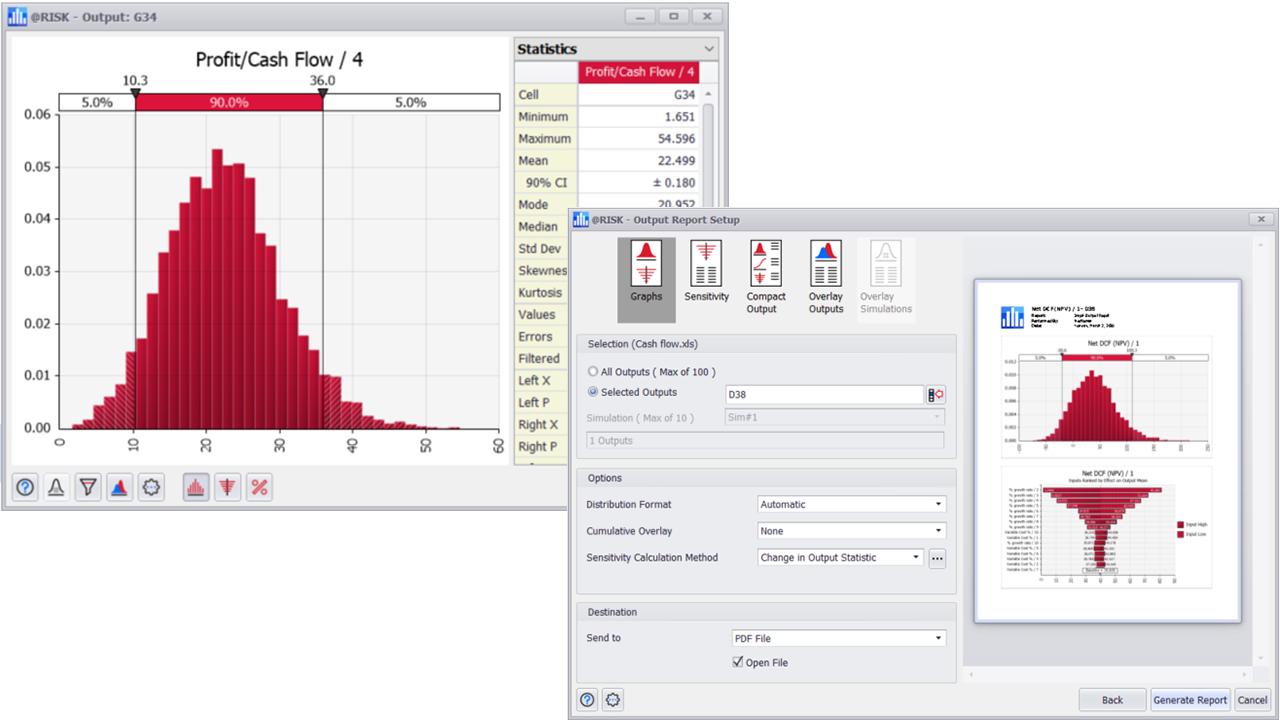
Risk Excel Template
Finally, build a probabilistic model for the trip duration from Station 1 to Station i, with i=1,2,…12
i. First step is to remove outliers. If a bike has been rent out for more than 24 hours at a time, it is considered lost or stolen. Remove any trips longer than 24 hours (86,400 seconds). You can also remove more outliers if you think it is necessary.

ii. Considering the scatterplot below (Word document) and the location of the 12 stations, determine the probability distribution of the trip duration from Station 1 to Station i, with i =1, 2,…12.
You can use Arena Input Analyzer, @RISK, or any other statistical software you like. You may combine some (or even all) end stations to determine input probability distributions. Copy and paste your Arena Input analyzer results or Excel worksheet.
Copy and paste your Excel worksheet.